
By: Dawn Zoldi
When Andrew Clare, Ph.D. CEO of Elroy Air, and Jose Martin, Founder and CEO of Martin Solutions, joined Episode 119 of the Dawn of Autonomy podcast, they shared an unfiltered story of a novel aircraft company and the certification architect helping it fly, technically, legally, safely and at scale. The conversation, part of the show’s UTM and Infrastructure month, revealed why the Chaparral aircraft may be the most consequential autonomous large cargo drones operating in U.S. and global airspace today.
A Machine Built to Go Where Others Can’t
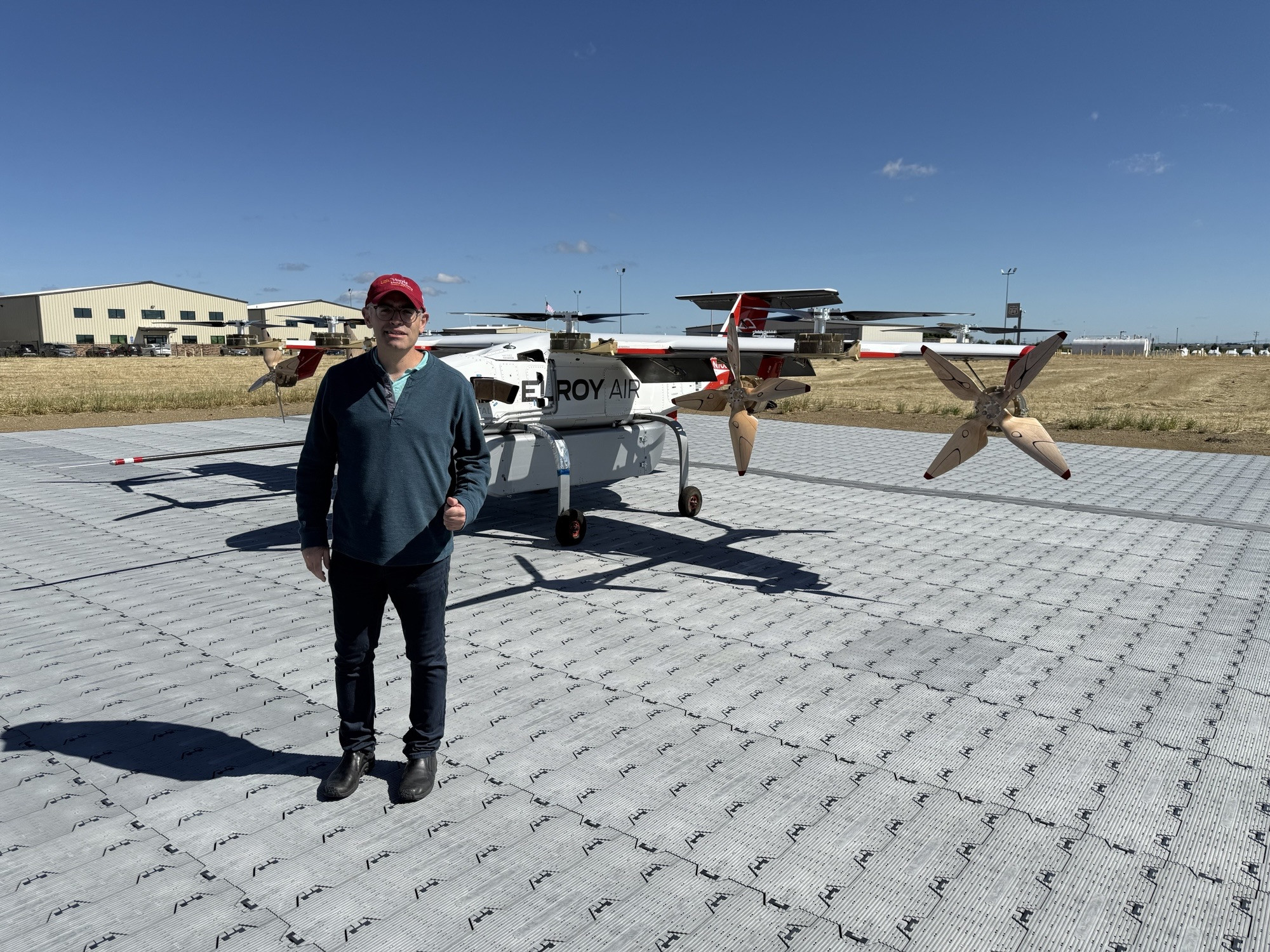
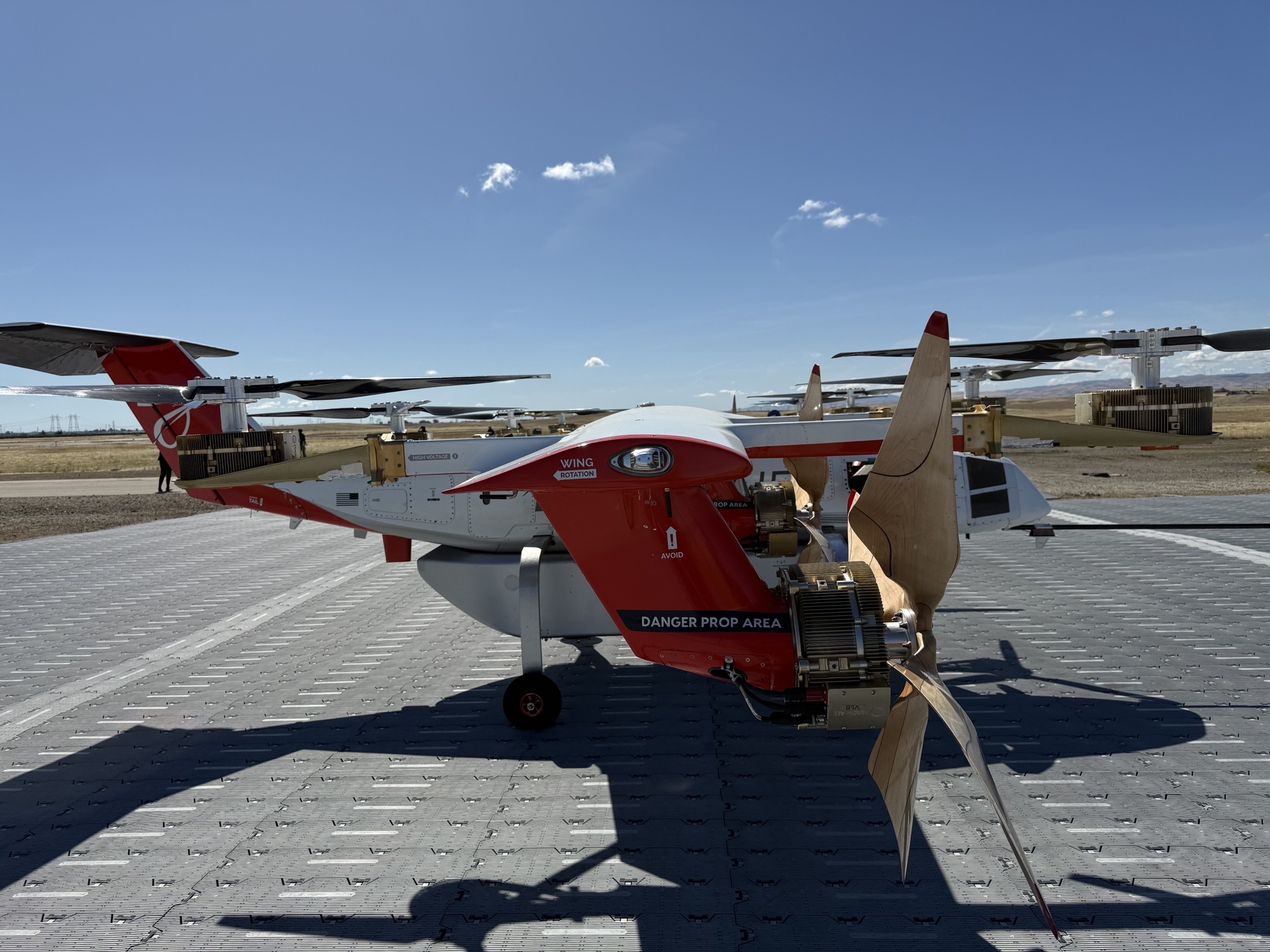
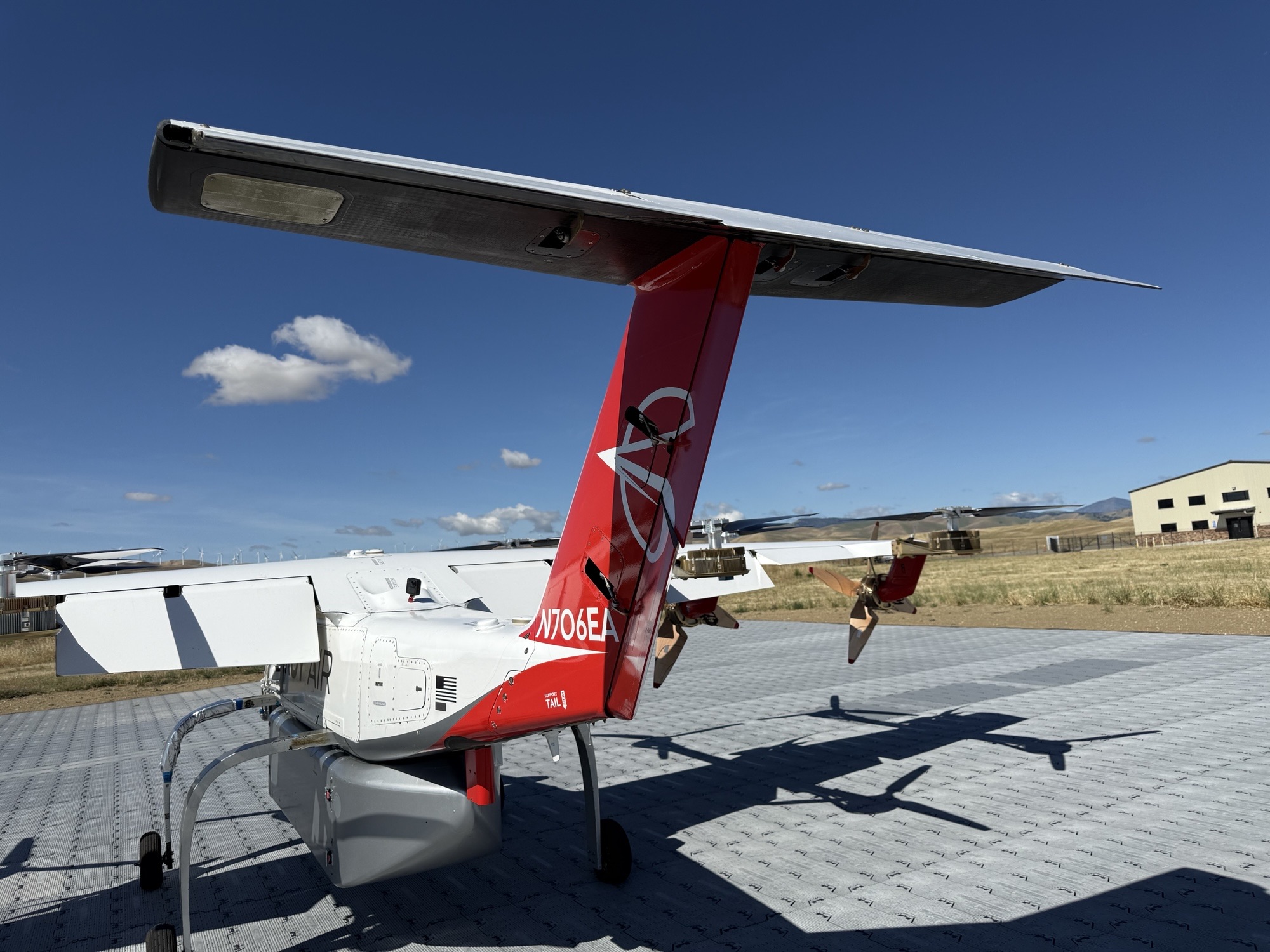
The Elroy Air Chaparral presents with a 30-foot wingspan. Elroy Air designed this hybrid-electric, vertical takeoff and landing (VTOL) cargo drone to autonomously carry up to 500 pounds with a maximum range of 450 miles. The operating sweet spot for the vehicle, Clare explained, is to travel about 300 pounds at distances over 300 miles. And did I mention…all of this with no pilot on board? That positions the Chaparral nicely to fill the middle mile logistics gap between large distribution hubs and regional delivery points, or between a heliport and an offshore oil platform.
But specs alone don’t tell the whole story. What makes the Chaparral genuinely different is its foundational design philosophy. Clare traces the company’s arc back to a set of deliberate bets made early in Elroy Air’s ten-year history.
The Four Bets That Made the Chaparral
“A long time ago here at Elroy Air, we made three very contrarian bets,” Clare explained, before revealing that a fourth followed naturally from the first three.
The first bet: focus exclusively on cargo. While much of the advanced air mobility (AAM) industry has chased passenger-carrying eVTOLs, Elroy Air locked in on freight from day one. They accepted a different, and, for regulators, far more manageable, risk profile. Relatedly, rather than chasing the transoceanic first mile or the backyard last mile, they picked the one in the middle.
The second bet: go VTOL. Conventional takeoff and landing aircraft require runways. The customers Elroy Air was talking to, from military logistics officers and offshore energy operators to FedEx and humanitarian relief organizations, simply don’t have them. VTOL fulfilled a direct customer need.
The third bet: go hybrid-electric. “You put fuel into the aircraft, and it goes,” Clare noted. “There’s no charging infrastructure required on the ground.” The Chaparral’s turbo-generator charges its own batteries in flight to yield electric propulsion efficiency without tethering operators to charging grids they don’t have and can’t afford to build. Defense customers operating forward in contested environments and commercial operators who want to plug into existing fuel supply chains benefit equally.
The fourth bet emerged as a logical conclusion: it has to be autonomous. No pilot on board, by definition, means no pilot required. “So it has to be autonomous,” Clare said simply. “And so, from the get-go of the company…we knew it had to be autonomous”.
The Dual-Use Dividend
Those four bets resulted in an aircraft that functions as a genuine dual-use asset. The same qualities that make the Chaparral valuable in the commercial middle mile make it indispensable for military logistics.
Elroy Air has assembled defense partnerships with the U.S. Army, U.S. Marine Corps, U.S. Air Force and Japan Ground Self-Defense Force. Clare articulated the unambiguous value proposition. “Why should we put a single one of our brave soldiers or airmen at risk to get food, water or medicine where it needs to go, when you can do it with a cargo drone such as ours?” Zero risk to our brave soldiers.”
On the commercial side, Elroy Air has compiled a signed backlog of over 1,400 units of demand, including from the Bristow Group, known for helicopter operations, and FedEx.
Martin views this dual-use potential as one of the company’s most strategically important assets. Importantly, he defines dual-use in three distinct, interlocking dimensions that go well beyond the standard military-commercial framing.
The first is the one most often discussed: safety data, approvals, and certification evidence generated in one sector can be leveraged in another. This means that future dual-use operators don’t have to restart the certification clock for either the FAA or the Department of Defense. “Why reinvent the wheel when we can reuse what is already good?” Martin asked. Every sortie flown under a defense contract, every deviation documented and mitigated, every Safety Risk Management (SRM) decision aligned with FAA Order 8040.4 builds a body of evidence that speaks to both audiences simultaneously and shrink the timeline and cost for any operator who follows.
The second dimension is organizational: Martin is actively working to structure Elroy Air’s regulatory posture so that a future type certification for the DOD does not require a separate, from-scratch type certification for the civilian side—and vice versa. That kind of dual-recognition architecture, still largely uncharted for autonomous hybrid-electric cargo platforms, would dramatically lower the barrier to entry for the commercial operators who hold those 1,400-plus units of signed backlog demand.
The third dimension is the one that most directly echoes the Chaparral’s own design philosophy: the reuse of existing physical infrastructure. Just as the aircraft itself needs no vertiport, no charging station and no purpose-built drone port, Martin argues that the supporting systems around it should follow the same logic. Rather than designing detect-and-avoid (DAA) solutions that would require entirely new onboard hardware, and add a year or two to the Chaparral’s approval timeline, he and the team are actively investigating how to leverage infrastructure that already exists. This includes existing radar networks, LTE coverage and airspace monitoring tools. “Instead of trying to recreate,” Martin said, the goal is to ask: “How can we reuse infrastructure that is already there?”
This convergence of old and new threads the entire collaboration. As one example, the Houma-Terrebonne (HUM) Airport, historically the backbone of offshore helicopter operations that serves Louisiana’s oil and gas industry, now serves as a staging hub for the Chaparral. The team in Louisiana plans to integrate an autonomous cargo aircraft into one of the most operationally complex airspaces in the country, without requiring a single structural modification to the facility. The fuel is already there. The airspace relationships are already there. The operational culture, built over decades of crewed helicopter logistics to offshore platforms, is already there. Elroy Air and Martin Solutions do not ask that infrastructure change for the aircraft. They ensure that the aircraft fits what already exists. They then design the regulatory case to match.
The December Milestone; Building the Regulatory Foundation
In December 2025, the Chaparral completed its first true point-A-to-point-B cargo delivery. It moved more than 200 pounds of goods between two distinct locations autonomously. For Clare, it was the most important milestone he asked his team to achieve in 2025. “It showed that we are ready now to hit the road,” he said. That milestone didn’t happen in a regulatory vacuum. It required months of coordinated work between Elroy Air and Martin Solutions to build the approval architecture that made the flight legal and repeatable. That is the distinction Martin Solutions exists to create.
Jose Martin brings 21 years of certification experience to his collaboration with Elroy Air, including time with Transport Canada (TC) and FAA-delegated authority as a Designated Engineering Representative (DER) with a special delegation under 21.17(b), the special class rule that applies to novel, unconventional aircraft like the Chaparral. His multi-authority fluency spans the FAA, EASA, Transport Canada, and ANAC in Brazil, the institutions most relevant to any company with global ambitions.
Martin’s methodology with Elroy Air, and other clients, begins not with regulations but with the concept of operations (CONOPS). “We establish a very clear CONOPS with very clear steps of what we can do, what we cannot do, and how we can be successful in each one of those steps, considering safety at all times,” Martin explained. That means sitting with airport stakeholders, air traffic controllers and operators simultaneously, not sequentially to build the safety case collaboratively. This way, each party sees how their piece fits before the first waiver application is filed.
In this particular team-up, the regulatory terrain the Chaparral must navigate presents as genuinely novel. The “drone” is too large for Part 107, not clearly within the scope of the still-unpublished Part 108 and categorically different from the crewed eVTOLs for which the FAA designed the Special Federal Aviation Regulation (SFAR) for powered-lift. The Chaparral carries no passengers, operates with a remote pilot rather than an onboard crew, uses a hybrid turbo-generator rather than a pure battery pack and weighs roughly 2,200 pounds. This break-glass configuration combination has no peer or direct regulatory precedent.
Rather than waiting for that precedent to be written, Martin has been drawing on elements of Part 108’s draft language, the powered-lift SFAR and FAA Order 8040.4’s SRM framework to construct a bespoke safety case specifically for the Chaparral. Each sortie, deviation and mitigation results in flights that generate FAA-usable safety evidence. All of this turns flight operations into regulatory capital.
A Crawl-Walk-Run Strategy, Not a Waiting Game
One of the most important strategic choices Elroy Air made was to position itself as an OEM, not as a Part 135 cargo operator or “airline.” That distinction simplifies the regulatory picture considerably. It lets the company focus on aircraft development and manufacturing while specialized operators handle commercial freight operations.
It also allows Martin Solutions to develop CONOPS strategies that are operator-facing. This helps to enable each commercial or defense customer to build their own regulatory relationship using a consistent safety foundation.
Clare emphasized that his company is not waiting on rulemaking to generate revenue. “We don’t have to sit around and wait for Part 108. We don’t have to sit around and wait for certain things to happen for us to start our business right now,” he said. Existing regulatory pathways for commercial BVLOS drone operations, defined corridors and waiver frameworks are sufficient to get operations running in 2026, with rapid scaling to follow.
On top of that, a five-year exclusive partnership with Kratos Defense & Security Solutions, one of the United States’ largest drone manufacturers and the builder of the XQ-58A Valkyrie for the U.S. Air Force will help to scale that manufacturing. Kratos brings the production infrastructure. Elroy Air brings the platform. Martin Solutions assists with the certified operational architecture.
What OEMs and Novel Aircraft Developers Can Learn
The Elroy Air–Martin Solutions collaboration offers a replicable model for any company navigating novel aircraft certification. The first lesson is structural clarity: know whether you are an OEM, an operator, or both, before you approach a regulator. The second is stakeholder sequencing: bring air traffic control, airport management, customers, and the FAA to the table during CONOPS development, not after a waiver is filed. The third is evidence discipline: treat every flight operation as a data-generating event that builds your safety case incrementally, consistent with FAA Order 8040.4.
Martin distilled this framework into three pillars: CONOPS, organizational structure and safety management. “Establishing CONOPS, organization and how you manage safety are the three pillars that you really need to set at the beginning, as a foundation, with a clear roadmap of what are those steps,” he said. The fourth principle, which the Chaparral embodies more than most, is infrastructure minimalism: design to the customer’s actual operating environment, not to a hypothetical infrastructure build-out that may never come.
For any developer building something the regulatory system has no explicit box for, the Elroy Air approach offers a clear message: don’t wait for the box. Build the case that earns the approval.
The Road Ahead
Martin Solutions has been spotlighted previously on Dawn of Autonomy and covered by Autonomy Global for its certification methodology and its rare ability to translate novel aviation concepts into approved operations across multiple regulatory jurisdictions. That body of work now arguably has its most consequential test case in the Chaparral, an autonomous aircraft that carries 300 pounds across 300 miles, lands in a parking lot and asks almost nothing of the ground beneath it.
For its part, Elroy Air commercial operations are expected to begin in 2026, as defense customers also put the Chaparral to work in parallel. After an earthquake, a tsunami or a supply chain disruption, Clare envisions the aircraft “there serving those in need” alongside its routine military and commercial logistics missions. The signed backlog of 1,400-plus units, built on real customer pain points, suggests the market agrees.